


A sense of building tension. Visible is the chilled vapour emanating from my fellow runners as they execute the "pre-race" jiggle on the start line.
A rapid twitch of the hips.
I'm participating in my local weekly parkrun event and I'm focused. It's almost time...
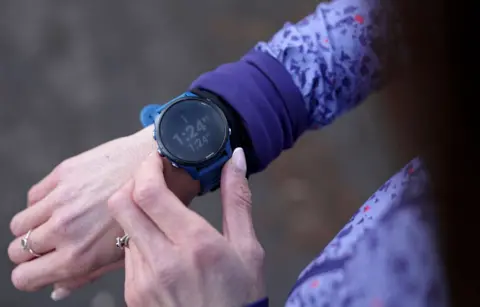
Hold on. I have to start my watch. As does the person beside me.
The person waiting tuts. I'm not moving until… there! GPS ready, and I'm running.
In the mele, it's challenging to spot a person without a fitness tracker on it. And this isn't only us runners who use them.
We're witnessing a thriving, multi-billion pound market. Names like Garmin dominate, all offering an broad array of various versions to fit a range of needs. Depending on how advanced the device you select, costs can start from £100 to a significant investment.
"I find it infuriating, I'm unable to relax."
"It provides solace… It feels like a supporter guiding me."
"Stop telling me about a bad night's sleep."
A small sample of the comments I've received from other device users when I inquire what they feel about theirs.
The Monitoring Conundrum
My current opinion on mine? At this moment, irritating. It's indicating I'm off pace, making me wonder whether the trees I'm running below are blocking my satellite signal.
Countless individuals of us strap these little devices onto our arms and keep them on 24/7, apparently at ease with the fact they're perpetually monitoring us.
Gone are the days when we depended on them only to give us an idea of our pedometer reading. Now, they can analyse our sleep quality, stress levels, heart rate variability (HRV), our VO2 max.
It's tricky to find a bodily function they aren't designed to measure.
But are they able to do what they advertise? And are the statistics we analyse a true reflection of our actual health? Do they boost our daily wellness, or do the plethora of measurements and motivational messages just increase our daily stresses?

A Love-Hate Relationship
"I do get a quite preoccupied with mine," an individual reveals.
While she loves how her device monitors her workouts, she finds some of its other capabilities "overwhelming" at times - a feeling initially realised during a major life event.
Until she found out she could put it into a specific mode, her smartwatch kept telling her she was not being active enough. Later on, the watch keeps telling her she's had a poor sleep score.
"I have a infant, I don't need to be informed I've not slept," she says. "I'm acutely aware all too clearly."
Couldn't she just stop wearing it?
"It's possible, perhaps, but I'm in this push-pull dynamic with it," she explains. "I appreciate it for its fitness insights, I sometimes question whether the myriad other functions it can now do is perhaps too much for me."
How Do They Work?
Every device of smartwatch has its own novel way of monitoring your bodily functions and processing your data, but the majority use optical sensors on the underside of the watch.
They usually emit tiny, coloured LED lights onto your wrist which can observe blood flow, detecting your heartbeat. Sophisticated devices analyse changes in the skin conductance that flows through the skin to assess your stress levels.
The Professional Viewpoint
A professor says that overall for smartwatches, it's a "difficult line" - while the continuously improving tech could potentially aid early diagnosis, "identifying issues before we notice anything", it could also turn us the tracked into the "anxious healthy".
He points out that some of the latest wearables can carry out tests like heart rhythm analysis, which continuously monitor how healthy the heart is. They can notify if someone is experiencing atrial fibrillation (AF), where there is irregular electrical activity in the heart causing an arrhythmia.
This does not mean someone is imminently going to suffer a heart attack, but it can give an early warning they might be more at risk of a heart problem in the long term.
But how to make sense of these readings is complicated. The expert fears that as further capabilities are introduced, people may struggle to fully comprehend their data.
"I'm not entirely convinced that having the capacity to monitor so many metrics is such a good idea," he says.
A professor studying cardiology echoes this sentiment. Research into the influence of wearable tech on a cohort of heart condition patients suggested a minority of those who were given devices to monitor their condition experienced greater stress and were "had a higher tendency to use medical services".
She observed a cycle with her patients - they saw a alarming metric on their watch. They grew concerned. Their pulse rose. They got even more concerned. They looked a second time, and their reading rose further.
"When people are presented with numbers about ourselves that we can't properly interpret then, naturally, we are going to want to know more," the psychologist says. "We check, we obsess - it becomes a feedback loop."
